Share
Keynote Speaker
Dr. Paul Dongha
Head of Responsible AI & AI Strategy, NatWest Group, Ex Co-Chair of Ethics Board, Generative AI Assurance expert, Public speaker, C-suite advisor, Harvard Business School
Popular talks
- How to create and operationalize an AI Governance and compliance program from scratch
- How to mobilise, create and set up your organization’s AI Strategy in line with your overall business strategy
- How to mitigate against the most prevalent risks of AI
- Preparing Your Workforce for AI – how do you ensure your people can create an AI-first organisation
- +3
Talks
Popular talks by Dr. Paul Dongha
-
How to create and operationalize an AI Governance and compliance program from scratch
Adopting and deploying AI at scale, is not just an IT activity, it a leadership imperative, which demands involvement from multi-disciplinary teams. It needs to be driven from the boardroom with clear accountability and a strong mandate. Designing Foundational Governance Frameworks: Master the blueprint for building an AI governance structure from…
Adopting and deploying AI at scale, is not just an IT activity, it a leadership imperative, which demands involvement from multi-disciplinary teams. It needs to be driven from the boardroom with clear accountability and a strong mandate.
Designing Foundational Governance Frameworks: Master the blueprint for building an AI governance structure from the ground up, ensuring ethical alignment and accountability at every stage of the AI lifecycle.
Operationalizing Global Compliance: Transition from theory to practice by integrating regulatory requirements and industry standards directly into existing technical workflows and business processes.
Risk Mitigation and Ethical Guardrails: Implement robust auditing practices and bias-detection mechanisms to protect your organization from legal, reputational, and operational risks.
Scalable Oversight for Rapid Innovation: Establish a dynamic governance model that evolves alongside emerging AI technologies, allowing for fast-paced innovation without compromising safety or security. -
How to mobilise, create and set up your organization’s AI Strategy in line with your overall business strategy
Bridging the Strategic Gap: Master the art of aligning AI roadmaps with core business objectives, ensuring that technology serves as a value-multiplier rather than a siloed experiment. Architecting the AI-Ready Culture: Insights into mobilizing cross-functional leadership and creating organizational “data-literacy” required to move from initial pilot programs to enterprise-wide adoption. Operationalizing Innovation: A…
Bridging the Strategic Gap: Master the art of aligning AI roadmaps with core business objectives, ensuring that technology serves as a value-multiplier rather than a siloed experiment.
Architecting the AI-Ready Culture: Insights into mobilizing cross-functional leadership and creating organizational “data-literacy” required to move from initial pilot programs to enterprise-wide adoption.
Operationalizing Innovation: A deep dive into the practicalities of setting up specialized “AI Centres of Excellence” (CoE) and selecting the right tech stack to future-proof your competitive advantage. -
How to mitigate against the most prevalent risks of AI
A step-by-step roadmap to ensure even as technology rapidly shifts, you can mitigate against some of the biggest categories of risk: accuracy and reliability – how can you measure accuracy in AI and what is ‘good enough’? fairness and bias – how to identify and resolve issues that can alienate your customers…
A step-by-step roadmap to ensure even as technology rapidly shifts, you can mitigate against some of the biggest categories of risk:
accuracy and reliability – how can you measure accuracy in AI and what is ‘good enough’?
fairness and bias – how to identify and resolve issues that can alienate your customers and regulators
interpretability, explainability and transparency – how to explain decisions made by AI
accountability: how do you ensure the right people in your organisation take ownership for AI decisions?
privacy – how do you prevent data leaks from AI and protect your customer’s private data?
security – how can you prevent cyber-attacks and AI jail-breaking?
intellectual property and confidentiality – how can you ensure your AI does not break copyright and IP laws? -
Preparing Your Workforce for AI – how do you ensure your people can create an AI-first organisation
Cultivating an AI-First Mindset: Strategies for shifting organizational culture from technology-aversion to “augmented intelligence,” ensuring employees view AI as a partner in productivity rather than a threat to job security. Strategic Upskilling and Reskilling Roadmaps: A blueprint for identifying future-critical skills and implementing continuous learning frameworks that evolve as rapidly as the…
Cultivating an AI-First Mindset: Strategies for shifting organizational culture from technology-aversion to “augmented intelligence,” ensuring employees view AI as a partner in productivity rather than a threat to job security.
Strategic Upskilling and Reskilling Roadmaps: A blueprint for identifying future-critical skills and implementing continuous learning frameworks that evolve as rapidly as the AI landscape itself.
Redesigning the Human-in-the-Loop Workflow: Expertise in restructuring roles and responsibilities to maximize human creativity and empathy while leveraging AI for high-speed data processing and automation.
Leading Through the Transition: Leadership tactics for managing the “change fatigue” associated with rapid digital transformation, focusing on transparent communication and psychological safety. -
Sustainable and Durable AI How to navigate the tension between technological performance and environmental sustainability
Architecting Carbon-Efficient AI Systems: Strategies for optimizing AI use (eg utilizing smaller, “lean” architectures and grid-aware computing—to reduce energy consumption without sacrificing accuracy. Navigating the Ethical-Environmental Trade-off: Expert frameworks for balancing the “hidden costs” of AI—including water scarcity for data center cooling and the extraction of rare minerals—against the strategic business value…
Architecting Carbon-Efficient AI Systems: Strategies for optimizing AI use (eg utilizing smaller, “lean” architectures and grid-aware computing—to reduce energy consumption without sacrificing accuracy.
Navigating the Ethical-Environmental Trade-off: Expert frameworks for balancing the “hidden costs” of AI—including water scarcity for data center cooling and the extraction of rare minerals—against the strategic business value of high-compute models.
Decoupling Innovation from Emissions: A blueprint for operationalizing “Green AI” through integrated ESG frameworks.
Sustainable Governance as a Competitive Advantage: Guidance on building accountability through transparent auditing and ethical alignment, ensuring AI initiatives drive long-term value rather than reputational risk.
Financial Operations – how to guide organisations in forecasting AI compute costs and the trade-offs with accuracy and ethical alignment. -
What is Agentic AI – Myths and Reality How to cut through the noise with technical realism and business acumen
Demystifying Autonomous Agency: Distinguishing between scripted automation and true “agentic” behaviour, providing an easy-to-grasp blueprint to help leaders identify which systems can actually reason, plan, and execute multi-step tasks and which simply cannot. The Reality of the “Agentic Loop”: A deep dive into the current limitations of LLM-based agents—from hallucination risks to…
Demystifying Autonomous Agency: Distinguishing between scripted automation and true “agentic” behaviour, providing an easy-to-grasp blueprint to help leaders identify which systems can actually reason, plan, and execute multi-step tasks and which simply cannot.
The Reality of the “Agentic Loop”: A deep dive into the current limitations of LLM-based agents—from hallucination risks to infinite loops—and the practical engineering required to move from experimental demos to reliable production tools.
Separating Hype from ROI: Strategic frameworks for evaluating “Agentic AI” vendors and internal projects, ensuring investments are focused on measurable gains rather than chasing the “all-capable digital employee” myth.
Safety and Human Oversight in an Agentic World: Expert guidance on the “Human-in-the-Loop” architectures necessary to maintain control and accountability as AI agents gain increasing autonomy over digital workflows and sensitive data. -
Artificial General Intelligence, Artificial Super Intelligence – what it means, when it might be achieved and what that means for society?
Navigating the Path to AGI: Decoupling the hype from technical reality by defining “Artificial General Intelligence”—from today’s emerging reasoning models to systems that match human cognitive flexibility across every domain. The Superintelligence Divide: Strategic analysis of the transition from AGI to ASI (Artificial Superintelligence), exploring the “intelligence explosion” hypothesis and the potential…
Navigating the Path to AGI: Decoupling the hype from technical reality by defining “Artificial General Intelligence”—from today’s emerging reasoning models to systems that match human cognitive flexibility across every domain.
The Superintelligence Divide: Strategic analysis of the transition from AGI to ASI (Artificial Superintelligence), exploring the “intelligence explosion” hypothesis and the potential for machines to solve problems beyond human comprehension.
Managing Existential Risk and Alignment: The ever-vexing ‘alignment problem”— ensuring that as systems gain superhuman planning and self-improvement capabilities, they remain fundamentally compatible with human values and safety.
Post-Scarcity Economics and the Future of Value: A look at the societal shifts triggered by AGI, including how organizations must redefine work, merit, and purpose in an era of radical abundance.
Universal Basic Income: explore the viability of allowing society to receive an income in a work of abundance, divorced form their own productivity.
Biography
About Dr. Paul Dongha
Dr Paul Dongha is a deep technologist who has pioneered the development and implementation of responsible AI strategies in large financial organisations. His approach brings together the troika of technological advancement, corporate integrity and the responsible use of AI. Paul is currently Head of Responsible AI and AI Strategy at NatWest Group and has extensive hands-on experience of building service-based, high-performance systems that use Big Data. Paul alos chairs Natwest Group’s AI & Data Ethics Board.
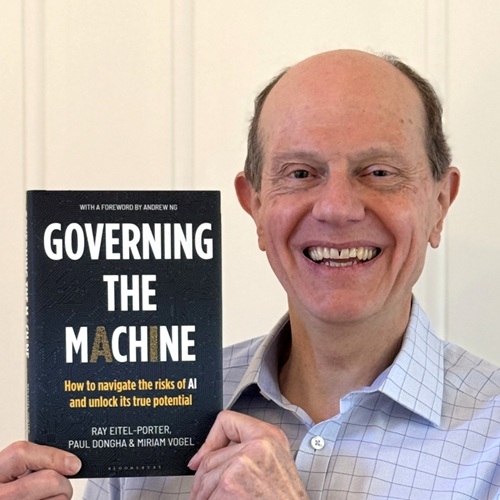
Paul Dongha is the author of Governing the Machine: How to Navigate the Risks of AI and Unlock Its True Potential, winner of the 2026 British Book Awards and voted FT Book of the Month in 2025.
Paul is a frequent international speaker – having given keynotes on both sides of the Atlantic, including speaking at the prestigious NY and London AI Summits. For over 30 years, Paul Dongha has been an expert on Agentic AI models. These are autonomous systems that use advanced reasoning to set goals, plan, reason and problem-solve with minimal human intervention. Paul believes AI should be used as a tool to augment human work rather than just replace it. His experience and expertise has guided business leaders looking to balance innovation with accountability and trust as they implement this fast-changing technology. He believes that the adoption and deployment of AI at scale is a leadership imperative that must be driven from the boardroom and not the IT department.
As a visionary leader, boardroom advisor and advocate for human rights, Paul believes that in order for AI to fully benefit humankind, business must mitigate its risks and pitfalls with the sensible implementation of guardrails. He is an active participant in international forums, policy discussions and projects aimed at setting global standards for responsible AI. As well as working with the UK Government, Paul works alongside the UK Competition and Market Authority, the UK banking regulators, PRA and the FCA.
Paul has built the framework and driven the mindset of AI policy in many large firms, including Lloyds Banking Group, where he was Group Head of Data and AI Ethics. He has also had posts at Fujitsu Research, HSBC and Credit Suisse.
Paul teaches AI Ethics, AI Governance and AI Strategy at Oxford Said, Harvard and Henley Business schools. Paul studied for a B.Sc., Masters and PhD at Manchester University, publishing his thesis on Agentic AI in 1996 – many years before people were even aware of its existence. Paul has also volunteered for the St Giles charity, where he provided mentorship and career advice to the adult caseworkers of repeat drug-related crime offenders. Additionally, he has mentored sixth-form and university students.
Testimonials
What clients say about Dr. Paul Dongha
“Paul’s appearances at events like The AI Summit New York and London have consistently elevated the discourse.. As a speaker, Paul is exemplary.. his presentations and panel contributions are marked by thoughtful, practical insights that deftly balance innovation with responsible AI frameworks”
“His ability to highlight where the industry should be moving towards and sharing valuable insights allowed the audience to become eager to answer questions.. Paul can initiate ideas and present complex concepts in an understandable manner. ”
“Dr Dongha delivered a compelling and thought-provoking presentation on 'Generative AI: Mitigating and Managing Ethical Risks.' His in-depth knowledge of the intersection between AI technologies and ethical considerations was evident throughout his talk. Not only did he provide a clear and accessible breakdown of the risks involved, but he also offered actionable insights on how businesses can address these challenges while ensuring responsible AI deployment”
“Paul’s ability to break down complex topics into clear, actionable insights was truly impressive. Dr. Dongha's presentation was a highlight of the event, reflecting his status as a leading authority in his field.”
“Dr Paul Dongha was a stellar speaker at the AI for Business Summit Latam in Bogota in July 2025.. in front of an executive audience full of Latam corporate leadership.. . If you are looking for a worldwide expert in Responsible AI, AI Ethics and Sustainability, look no further.”
How to book Dr. Paul Dongha
Answers on fees, availability and booking process.
How do I book Dr. Paul Dongha for a keynote speech?
You can book Dr. Paul Dongha through London Speaker Bureau by submitting the enquiry form on this page or calling our team. One of our consultants will respond promptly with Dr. Paul's current availability, speaking fees and any specific requirements for your event.
What are Dr. Paul Dongha's speaking fees?
Dr. Paul Dongha's speaking fees depend on the event format (in-person or virtual), the location, the length of the engagement and the level of customisation required. Please contact London Speaker Bureau for an up-to-date fee quote for Dr. Paul tailored to your event.
What topics does Dr. Paul Dongha speak about?
Dr. Paul Dongha speaks on Artificial Intelligence, Authors, Digital, Future, Future of Work. Talks can be shaped around your audience, industry and strategic objectives - share your event brief with London Speaker Bureau and we will work with Dr. Paul to align the content with your delegates and goals.
Is Dr. Paul Dongha available for international events?
London Speaker Bureau can book Dr. Paul Dongha for events worldwide, subject to Dr. Paul's schedule. Please send us your event date, location and format and we will confirm availability and handle travel and logistics on your behalf.
Does Dr. Paul Dongha deliver virtual or online keynotes?
Virtual and hybrid keynotes are now a standard part of the speaking industry. Please contact London Speaker Bureau to confirm whether Dr. Paul Dongha is available to deliver a virtual session for your event and on which platform (Zoom, Microsoft Teams, a bespoke studio or your own).
How long is a typical keynote by Dr. Paul Dongha?
Most keynote speeches run between 45 and 60 minutes, often followed by a 15-30 minute Q&A. Other formats - shorter conference slots, panel appearances or longer workshop sessions - may also be possible. Share your agenda with London Speaker Bureau and we will confirm what Dr. Paul can accommodate.
Can Dr. Paul Dongha tailor the keynote to our industry and audience?
London Speaker Bureau will brief Dr. Paul Dongha on your audience profile, sector and objectives so the keynote can be shaped around your event. The level of customisation possible depends on the speaker and the lead time - contact us with your brief and we will confirm what Dr. Paul can offer.
What languages does Dr. Paul Dongha present in?
Dr. Paul Dongha delivers keynotes in English. This profile may not list every language available; ask London Speaker Bureau to confirm. If you require simultaneous interpretation or a multilingual format, please mention this in your enquiry and London Speaker Bureau will arrange it for you.
What makes Dr. Paul Dongha a strong fit as a keynote speaker?
Dr. Paul Dongha's areas of expertise include Artificial Intelligence, Authors, Digital, Future, Future of Work. To get a clear sense of Dr. Paul's style, credentials and how they engage an audience, please review the biography, popular talks and any videos or testimonials shown on this page, or request a detailed speaker brief from London Speaker Bureau.
What kind of events can Dr. Paul Dongha speak at?
Dr. Paul Dongha can be booked through London Speaker Bureau for corporate conferences, leadership events, internal team meetings, association gatherings and private client engagements where expertise in Artificial Intelligence, Authors, Digital, Future, Future of Work is relevant. Details of Dr. Paul's background and previous engagements are included in the biography above; contact us if you would like a more detailed list of past clients or case studies.
Does Dr. Paul Dongha offer workshops, panels or fireside chats in addition to keynotes?
Beyond keynote speeches, many of the speakers on our roster also take part in workshops, executive masterclasses, panel discussions and fireside chats. Contact London Speaker Bureau with your preferred format and we will confirm what Dr. Paul Dongha is able to offer alongside or instead of a keynote.
How far in advance should we book Dr. Paul Dongha?
We generally recommend enquiring at least three to twelve months in advance to secure your preferred date with Dr. Paul Dongha, particularly during peak conference seasons. Where possible we also accommodate shorter lead times - please contact London Speaker Bureau to check Dr. Paul's current availability for your dates.
Similar Profiles
Speakers you may also like alongside Dr. Paul Dongha
-
Ray Eitel-Porter Globally-recognized expert in AI governance, Responsible AI, and AI safety and ethics -
Toju Duke Responsible AI Advisor, Author “Building Responsible AI Algorithms”, Founder of Diverse AI -
Didem Un Ates AI Strategy & Responsible AI Expert, Board Director and Founder of LotusAI -
Paul Gibbons CAIO Advisor, AI Strategy, Culture & Adoption, Creator of the Adaptive Adoption & Behavioral AI Models, Author of 8 books -
Andreas Welsch Top 10 AI Advisor, Thought Leader, and Former SAP AI Executive